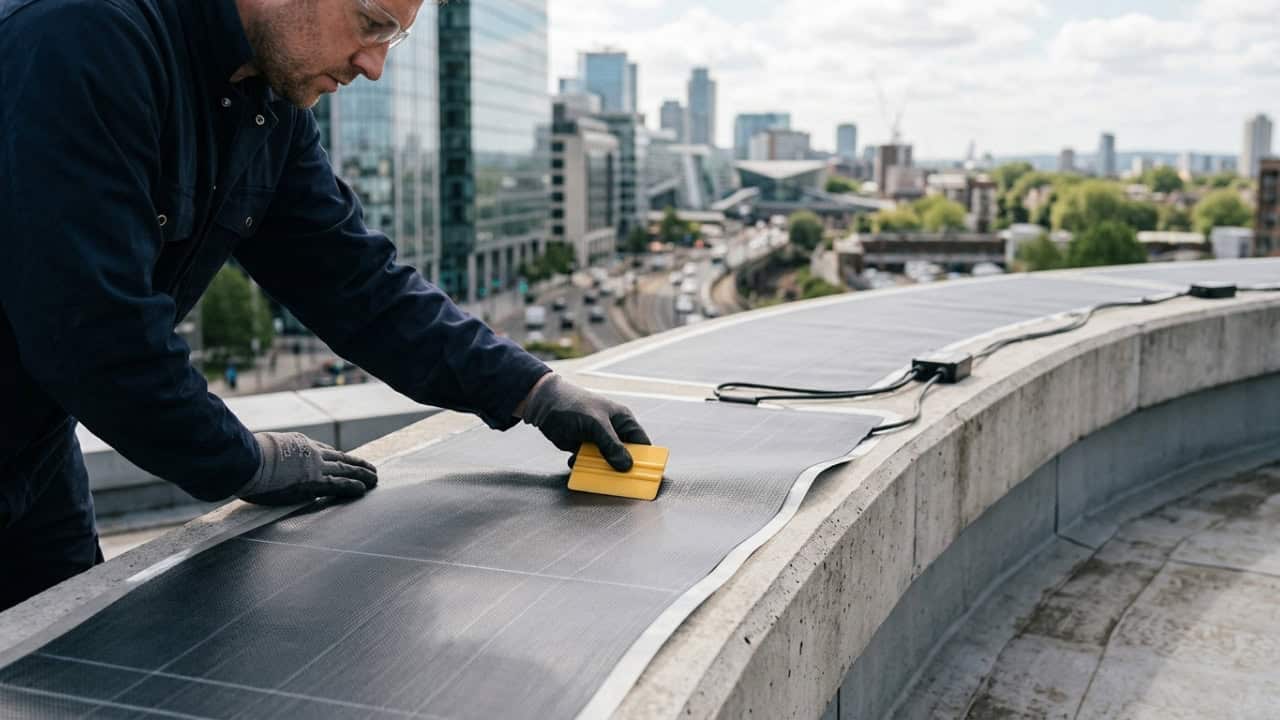
Renewable energy technology has just taken a giant leap towards practicality and absolute urban efficiency. Ultra-thin solar cells developed by researchers promise to transform any surface into a source of clean and inexpensive energy. Thinner than a human hair, this innovation eliminates the need for heavy silicon structures on rooftops.
What are MIT’s ultrathin solar cells ?
According to a study conducted by MIT, this innovative technology uses printed semiconductor inks to create high-performance electronic fabrics. Unlike conventional solar panels, which are heavy and fragile, these films can be folded and transported with extreme ease to any environment.
Unlike rigid panels, these sheets are extremely lightweight and can be applied to boats, tents, or even drone sails to extend flight range. The material’s versatility allows for light capture on curved or irregular surfaces where traditional silicon could never be safely installed.
Electronic Printing: The cells are manufactured through a layered printing process, similar to modern industrial screen printing.
Dyneema reinforcement: The solar material is bonded to an ultra-resistant fabric that prevents tearing without adding significant weight to the assembly.
Ready to Use: The final layer receives an industrial adhesive that allows for instant bonding to smooth or rough surfaces.
How does the installation of these solar stickers work?
The major competitive advantage of this technology lies in its special adhesive layer, which allows it to be attached to a variety of surfaces without the use of screws. The installation process is comparable to applying decorative wallpaper, requiring very little technical training before the system can begin operating.
This drastically reduces labor costs and makes energy generation feasible in locations previously considered impossible, such as the facades of mirrored buildings. Furthermore, because they are modular, the user can add more collection areas as their energy needs increase over time.
- Instant contact adhesion to metal or plastic surfaces.
- Absence of structural perforations in the roof or wall.
- Plug-and-play connection for battery storage systems.
- Simplified maintenance with quick replacement of affected modules.
Special adhesive layer facilitates solar installation on mirrored building facades – MIT / Press Release
What are the advantages of ultra-thin solar cells compared to traditional ones?
Portability is the key factor in this new era, allowing solar energy to be brought to disaster areas or remote regions. While a traditional panel weighs kilograms and requires heavy logistics, hundreds of square meters of this new film can be transported in a single, standard box.
Furthermore, the efficiency per weight is far superior, generating up to 18 times more energy per kilogram than conventional silicon models. This metric is vital for space or aeronautical applications, where every gram saved translates into fuel savings and greater economic viability of the project.
| Feature | Traditional Panel | Ultrafine Cell |
|---|---|---|
| Estimated Weight | Elevated (Rigid) | Ultra Lightweight (Flexible) |
| Installation | Complex / Fixed | Adhesive / Portable |
| Power per kg | Low Standard | 18x Higher |
How durable is this new flexible material?
Despite being thin and lightweight, the cells are integrated into high-strength fabrics, such as Dyneema, ensuring complete protection against accidental tearing. This material is known worldwide for its extreme strength, being used in anchor cables and high-tech bulletproof vests.
Ongoing research is now focused on developing transparent coatings that protect organic material from moisture and oxygen, increasing its outdoor lifespan. The current challenge is to create a protective barrier that is as flexible as the cells themselves, without compromising the transparency necessary for sunlight.
When will this technology reach the consumer market?
Currently, the project is in the industrial refinement phase in laboratories, seeking global partners for sustainable large-scale production. The goal is to transform the manufacturing process into something as fast and inexpensive as newspaper printing, using continuous production rolls.
The expectation is that, in a few years, we will be able to buy solar energy rolls in construction stores for immediate and simplified home use. This democratization of access to photovoltaic technology could be the definitive turning point for the global energy matrix in the coming decades.
Source: www.bing.com
Source Link