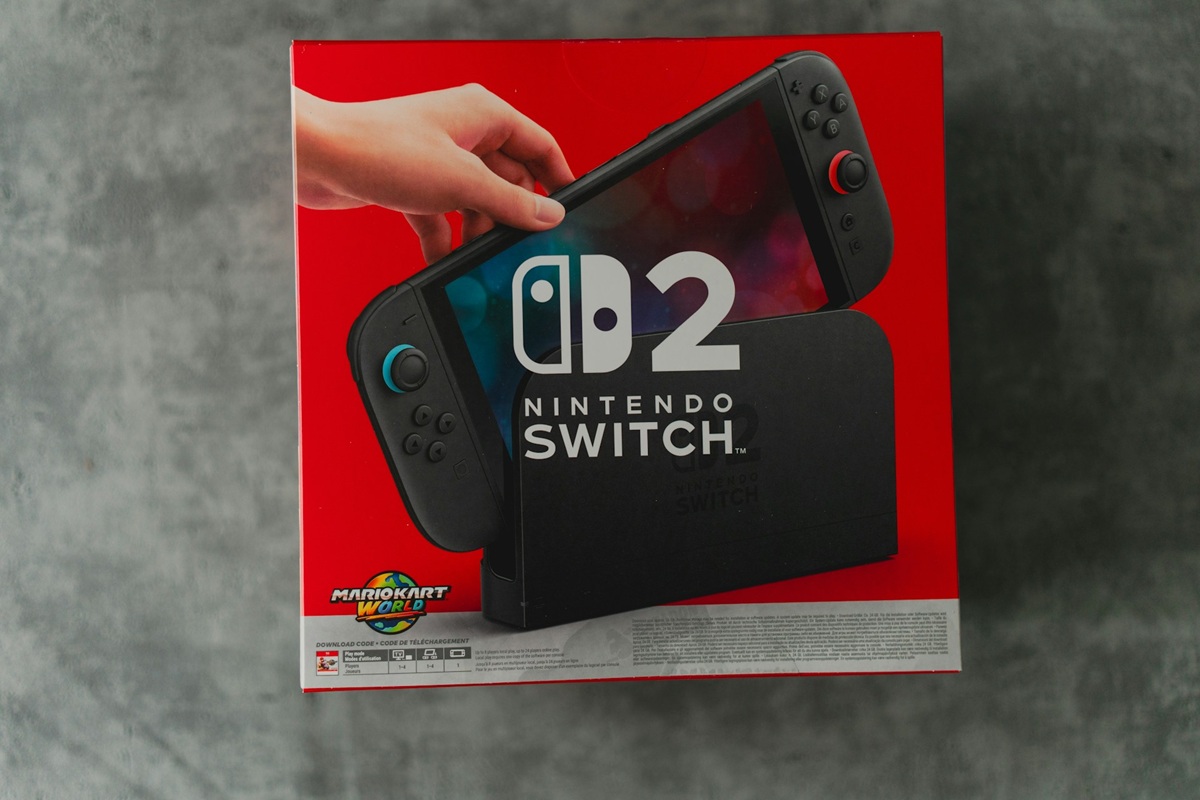
Do you have doubts about the connectivity of your new Nintendo console? Rest assured, you are in the right place!
For those who are out of the loop, a brief contextualization: compatibility with the Wi-Fi 6 standard on Nintendo Switch 2 works in the bands 2.4GHz and 5GHzusing Orthogonal Frequency Division Multiple Access (OFDMA) to manage multiple connected devices with less loss of speed.
For those who have older routers, rest assured, as the console also maintains support for WiFi 5and the Wi-Fi 6 membership is not mandatory to play online or access the Nintendo eShop.
Network performance and latency on Switch 2
The Nintendo Switch 2with a lot of effort, manages to deliver the resolution of 4K at 60 frames per second (FPS) when fitted to the dock in TV modehowever, when the subject is play online on Switch 2the quality of the experience directly depends on the home network infrastructure.
In matches ofMario Kart Worldwith up to 24 simultaneous playersa faster connection reduces noticeable lag on congested networks. Wi-Fi 6 incorporates the feature OFDMAwhich distributes traffic between devices more efficiently and maintains more consistent speeds under load.
Compared to Nintendo Switch Wi-Fi originatesl, the WiFi 6 offers more agile gameplay response and faster downloads eShop.
The connection stability It also improves when several devices share the same router. In practical tests, routers with Wi-Fi 6 they support a greater number of simultaneous devices without a sudden drop in performance, a point in which they easily outperform models based on Wi-Fi 5.
| Technical specification | WiFi 5 | WiFi 6 |
|---|---|---|
| Traffic distribution between devices | Less efficient under multiple load | Built-in OFDMA for less degradation |
| Latency in congested networks | Greater instability during peak usage | Reduced lag in multiplayer matches |
| Capacity of simultaneous devices | Bottom under same network infrastructure | Superior, maintaining consistent speeds |
| Comparison with original Switch | Equivalent to previous console standard | More agile response and faster downloads |
Frequency bands and the 6 GHz myth
The console transitions between band of 5 GHz and 2.4 GHz to navigate the eShop and play online. A bruns 2.4 GHz it remains functional and is not outdated, contrary to what one of the recurring misconceptions about wireless networks suggests.
The most common confusion involves associate Wi-Fi 6 with the 6 GHz frequencybut this range belongs exclusively to the standard Wi-Fi 6Ea more recent review that is still rarely found on the market.
Even with the Wi-Fi 6 compatibilitythe Switch 2 does not access 6 GHz. The practical gain of migrating to a Wi-Fi 6 router focuses on downloads more fast and the possibility of lower latency during online matches, without drastic changes to the day-to-day experience with the hybrid Red Team of the consoles.
The investment may make sense for those who use overloaded home networksbut does not completely eliminate the instability found in problematic connections.
| Frequency | Matching Wi-Fi standard | Situation on Switch 2 |
|---|---|---|
| 2.4GHz | Wi-Fi 5 and Wi-Fi 6 | Functional and compatible, without being outdated (and suitable for long distances) |
| 5GHz | Wi-Fi 5 and Wi-Fi 6 | Used for browsing the eShop and playing online |
| 6GHz | Exclusive to Wi-Fi 6E | No console support; standard still little adopted |

Nintendo Switch Online subscription and costs
Access to internet multiplayer mode node Switch 2 requires subscription to the service Nintendo Switch Online. The Japanese giant maintains two modalities:
- Individual plan for one Nintendo account, with an annual value of R$ 21.90;
- Family plan for up to 8 Nintendo accounts, costing R$ 109.90per year.
The console uses the same internet service for online games and downloads from the eShop, either wireless connection or via Ethernet cable.
Where Wi-Fi 6 really makes a difference
THE WiFi 6 proves to be more advantageous in scenarios with high density of devices connected at the same time, such as houses with multiple consoles, smart TVs and smartphones working at the same time.
The technology reduces traffic bottlenecks and maintains fluidity even under intense use, but its usefulness decreases in environments with few connected devices.
Not all consoles on the market come with this support. THE PlayStation 5 is compatible with WiFi 6, but the Xbox Series X|S does not adopt the standard.
THE Switch 2even prepared for Wi-Fi 6, Does not require a newer router to work online. Common Wi-Fi 5 router old man of war, multiplayer matches continue to work, despite some annoying disadvantages, such as slightly higher latency and downloads slower.
| Console | Wi-Fi 6 compatibility |
|---|---|
| Nintendo Switch 2 | Compatible |
| Original Nintendo Switch | Not compatible |
| PlayStation 5 | Compatible |
| Xbox Series X/S | Not compatible |

Source: BGR

Source: www.adrenaline.com.br
Source link