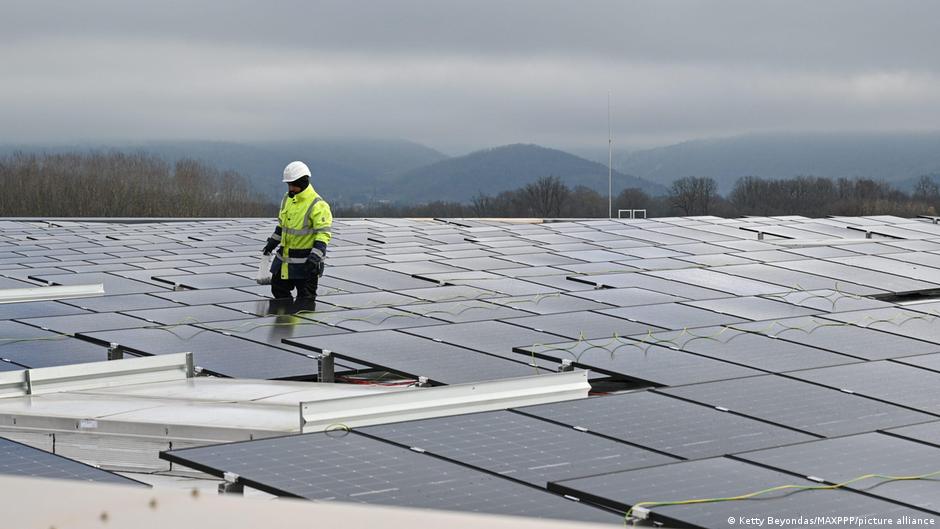
The European Commission has taken steps to block European Union funding for solar energy production technologies made in China, over fears that they could pose a threat to the security of the European electricity grid and even cause major blackouts.
The decision, confirmed on May 4, reflects growing concern in Brussels that Europe’s dependence on Chinese green technology is making the bloc vulnerable to security risks.
The financing ban focuses on solar inverters, components considered the “brains” of a solar energy system.
These inverters are the devices that convert solar energy into usable electricity. They are connected to the internet and, in many cases, can be accessed remotely for maintenance and software updates.
The worst case scenario: a Europe-wide blackout?
“All inverter companies have something like a kill switch,” Christoph Podewils, secretary general of the European Solar Manufacturing Council, told DW.
This type of mechanism, like other remote connections, is typically used for security or network stabilization purposes. However, cybersecurity experts warn that in a possible extreme scenario, hackers or hostile state actors could exploit these connections to disrupt power supplies.
“The worst-case scenario would be large-scale blackouts across Europe,” cybersecurity expert Swantje Westphal told DW.
This risk has been increasingly taken into account as solar energy advances into the composition of the European energy matrix. While this source accounted for 0.05% of the electrical energy produced in the European Union, this share jumped to 13.1% in 2025, according to the energy research organization Ember.
This advancement was supported by Chinese technology. By 2024, 61% of all inverters imported into Europe came from China, according to Geneva-based research group Loom.
Huawei and Sungrow are the two inverter manufacturers that dominate not only the European but the global market.
A small group of Chinese manufacturers has already supplied equipment for more than 220 gigawatts of installed solar capacity in Europe.
“To give you an idea, controlling around 10 gigawatts would be enough to cause major interruptions in the European electricity grid,” said Podewils.
Suspicious communication devices
There is no known record of Chinese-made inverters being used to shut down parts of the European power grid.
But concerns intensified after Reuters reported in 2025 that US energy officials discovered unauthorized communications devices inside some Chinese inverters.
“The threat is real,” Westphal said. “It’s not a made-up hypothesis.”
The debate over inverters comes as Europe reassesses its broader reliance on Chinese clean technology imports.
According to Loom, China accounts for 98% of solar panels and 88% of lithium-ion batteries imported by Europe.
The organization warned that remote access functions in connected energy technologies could create potential vulnerabilities across the entire electrical system.
Dominance of Chinese green technology in Europe
Brussels has adopted an increasingly strict stance towards Chinese imports seen as security risks or threats to European industry.
In March, the European Commission presented the so-called Industrial Acceleration Law, with the aim of directing more resources to green technologies produced in Europe, including batteries and electric vehicles.
The Commission also presented a review of the Cybersecurity Law, which will give Brussels more authority to restrict Chinese companies in critical infrastructure such as communications or energy supply in member states.
Under the new measures, EU resources administered directly by the Commission and institutions such as the European Bank for Reconstruction and Development can no longer be used to purchase solar inverters manufactured in China.
The restrictions do not apply to purchases made directly by Member States, and Chinese inverters already installed in Europe will be able to continue operating.
“It’s a step in the right direction,” Westphal said. “But we don’t ban these Chinese inverters from our markets.”
Can European suppliers fill the gap?
Currently, 80% of new solar systems installed in Europe rely on Chinese inverters, according to the European Solar Manufacturing Council.
If demand shifts away from Chinese suppliers, European manufacturers will have to fill a significant gap. Still, Podewils believes the European industry is ready.
“It is possible to expand production capacity in a few months to the level necessary to meet demand,” he said.
Inverters produced in Europe are expected to cost slightly more than Chinese alternatives — around 2% more, according to a European Commission official. But for Podewils, this additional cost is justified.
“It’s like insurance,” he said.
Source: www.bing.com
Source link