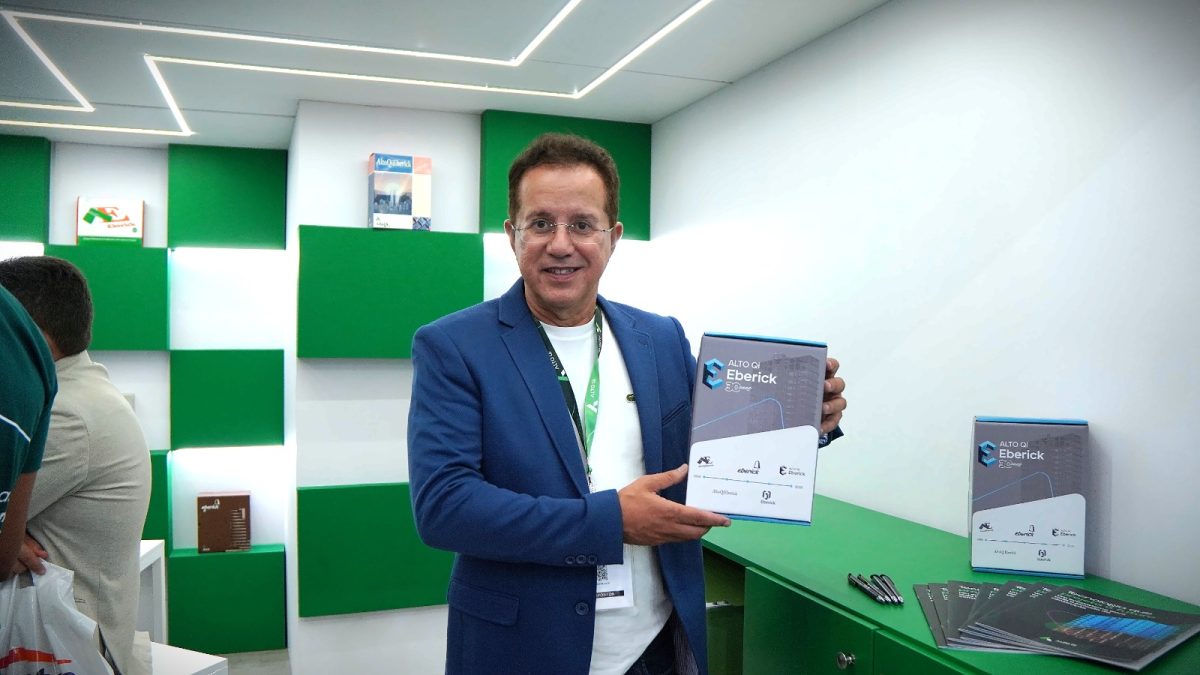
Rui Gonçalves, founder of AltoQi: from a childhood without electricity in the interior of Santa Catarina to commanding a company with more than 67 thousand customers in 15 countries and a projection of R$110 million in revenue for 2026.Photo: Disclosure/AltoQI/ND More.
Before talking about digital transformation, Rui Gonçalves experienced the most basic transformation: the arrival of electrical energy. He was born in Barranco Alto, in the interior of Islet in Vale do Itajaí, Santa Catarina, in a house without electricity, running water and a bathroom outside.
To get to school, I crossed a river in a boat. The sneakers were placed in a plastic bag so they wouldn’t get dirty. On the other side, he washed his feet, put on his conga and walked about three kilometers.
The community became even more isolated when a drainage canal interrupted land access. The situation only changed when the military set up a camp nearby.
They built a bridge. Rui was just over ten years old. An engineer lieutenant explained that, to build a bridge, it was necessary to study mathematics. “To build a bridge, you need to study mathematics.” The phrase stuck and shaped everything that would come later.
The family moved to Itajai. The mother sewed to support her children. Rui started working at the age of 13, as an office boy and waiter. The school and football performance opened the door to a traditional school in the city, through a grant conditioned on the presentation of a certificate of poverty issued by the city hall.
He entered as a social exception, and responded with performance. “You are not invited to parties, you are not invited to study in a group. Prejudice is not explicit, it happens in the looks”, remembers Rui. He became one of the best students in the class.
The dream was engineering. But when taking the entrance exam, he made a pragmatic choice: he chose computer science. The course lasted four years, not five, and had part-time classes. He needed to work to support himself in Florianópolis. It happened. He was the only one on the bus in his class to get a seat.
The question that founded a company
In the penultimate semester of college, when I saw a civil engineering colleague calculate structures manually, I became concerned: “Isn’t there a program to do this?”
It existed. A piece of software from a São Paulo company that cost ten thousand dollars. Unthinkable in Brazil at the end of the 1980s, with uncontrolled inflation and a still embryonic computer market. The alternative was to create. Rui made a proposal to his colleague: “You teach me how to calculate, and I’ll write the program.”
In 1990, he formalized a partnership with two colleagues: José Carlos Pereira and Ricardo Eberhardt. Pereira joined for a practical reason: he had a car, essential for those who sold technology door to door in the interior of Santa Catarina.
Ricardo entered out of genius. He was considered the best student in the class. The “high IQ”. He suggested the name AltoQi. He was also responsible for the central development of the first product, ProViga.
The company was born in a one-bedroom apartment in the center of Florianópolis. Then he moved to a 1.70 meter high attic above a computer store, where the partners hit their heads when they stood up.
It was literally a startup before the term existed. “We didn’t even have money for a real office. But we had the product”, recalls Rui.
The loss and tribute that became a national reference
In 1993, Ricardo Eberhardt died of cancer, aged 27. He was the company’s main developer. AltoQi could have ended there. “He finished version 2.5 of ProViga in bed. It was one of the company’s great initial successes, and he didn’t even see its impact”, recalls Rui.
Faced with the loss, he made the opposite move by giving up: he decided to integrate all software into a single system, something unprecedented in Brazil. With support from grants from Finep and CNPq through the Softex 2000 program, it took four years of development. The first real test was a four-story building in Tubarão, in the southern region of Santa Catarina. The calculation took 11 hours on a Pentium 100. It was slow, but revolutionary.
When naming the new system, Rui insisted on honoring Ricardo. “The name Eberick comes from the nickname he used. It was the way we found to immortalize someone who was fundamental for all of this to exist”, says the founder.
A “K” was added at the suggestion of a numerologist friend of the company. Launched in 1996, Eberick turns 30 in May 2026 as one of the most used reinforced concrete structural calculation software in the country.
In the last two years, around 200 thousand projects were developed on the platform, totaling more than 100 million square meters calculated.
From software to ecosystem: today’s AltoQi
If the company’s origins lie in structural calculation, the current strategy goes much further. AltoQi currently has more than 67 thousand customers in more than 15 countries, has more than 300 employees — mostly engineers — and operates as a digital ecosystem for civil construction.
In 2025, the company recorded revenue of R$80 million, with growth of 30% compared to the previous year. For 2026, the estimate is to reach R$110 million in revenue.
The new strategic phase also included the entry of ArcelorMittal as an investor, through Açolab Ventures, the steel company’s Corporate Venture Capital fund.
The operation directly connects project modeling to the industrial material supply chain. “The new AltoQi began to consolidate itself there. It was not just a change in product, but in market positioning, target audience and long-term strategy”, says CEO Felipe Althoff, who took over leadership of the company in 2020.
“When the engineer specifies in the project which steel will be used, this influences the entire supply chain. The project becomes the point of origin of industrial demand”, explains CEO Felipe Althoff, who took over leadership of the company in 2020 and has been leading the strategic repositioning.
Today, AltoQi’s customers include the country’s main construction companies, as well as public institutions such as the Army, Air Force and engineering universities. And the boy who crossed rivers to study continues building bridges.
“I still build bridges today”, Rui Gonçalves often says. “Construction is moving towards a more industrialized model. Making mistakes on the computer is infinitely cheaper than making mistakes on site.”
Source: www.bing.com
Source link