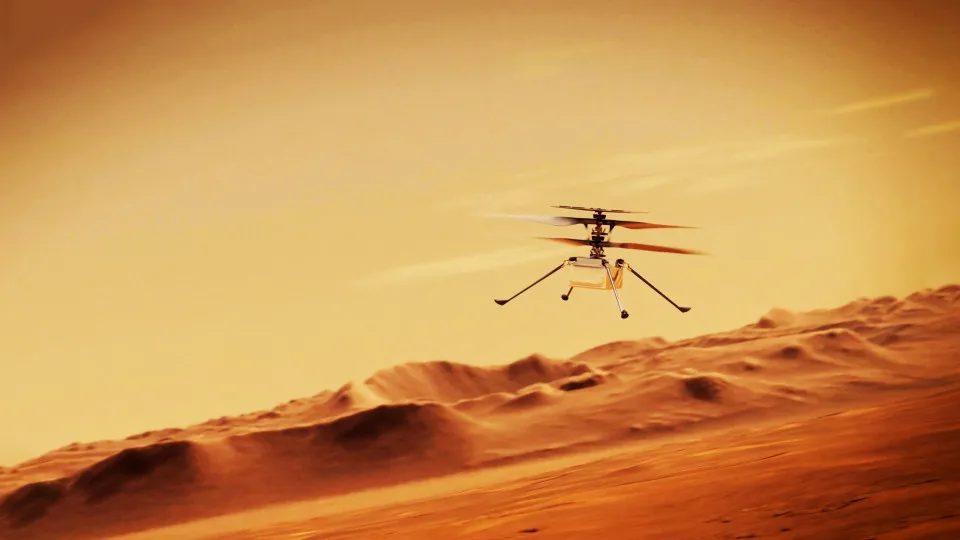
The NASA is developing a new generation of helicopters to explore Mars and is already celebrating the initial results of tests carried out with the equipment that should reach the red planet at the end of 2028.
The new models are part of the SkyFall project and are considered successors to Ingenuity, the small helicopter that made history by making the first powered flight on another planet in 2021.
According to NASA, the most recent tests, carried out in environments that simulate the Martian atmosphere, showed that the rotor blades of the new helicopters were able to reach a speed of Mach 1.08, overcoming the sound barrier.
The performance represents a significant improvement over Ingenuity, whose rotors operated at around Mach 0.7.
At the time of the original mission, NASA deliberately chose to keep the speed below the sound barrier to avoid possible technical problems related to friction, turbulence and the behavior of Mars’ thin air.
Now, with the experience accumulated in recent years, the agency believes it is ready to test more ambitious limits.
“The success of these rotor tests was a huge step towards proving the viability of flight in more extreme environments, something essential for next-generation vehicles,” said Shannah Withrow-Maser.
“We thought it would be great to reach Mach 1.05, but we managed to reach Mach 1.08 in the most recent tests. We are still analyzing the data and there is a possibility that we can achieve even more thrust. These new generation helicopters will be incredible,” he added.
If the schedule is maintained, the SkyFall mission will send three new helicopters to Mars in late 2028.
The goal will be to analyze the Martian surface in more depth and help identify safe areas for future manned NASA missions.
Ingenuity’s performance was considered much higher than expected by the space agency.
When it arrived on Mars, engineers believed that the helicopter would only be able to perform five experimental flights. However, the aircraft surpassed all predictions and completed 72 flights before suffering an accident in 2024, caused by a calculation error during an operation.
With the experience accumulated throughout the Ingenuity mission, NASA’s expectation is that the new helicopters will have even more advanced capabilities and will be able to operate in much more demanding conditions on the red planet.
Source: www.noticiasaominuto.com.br
Source link