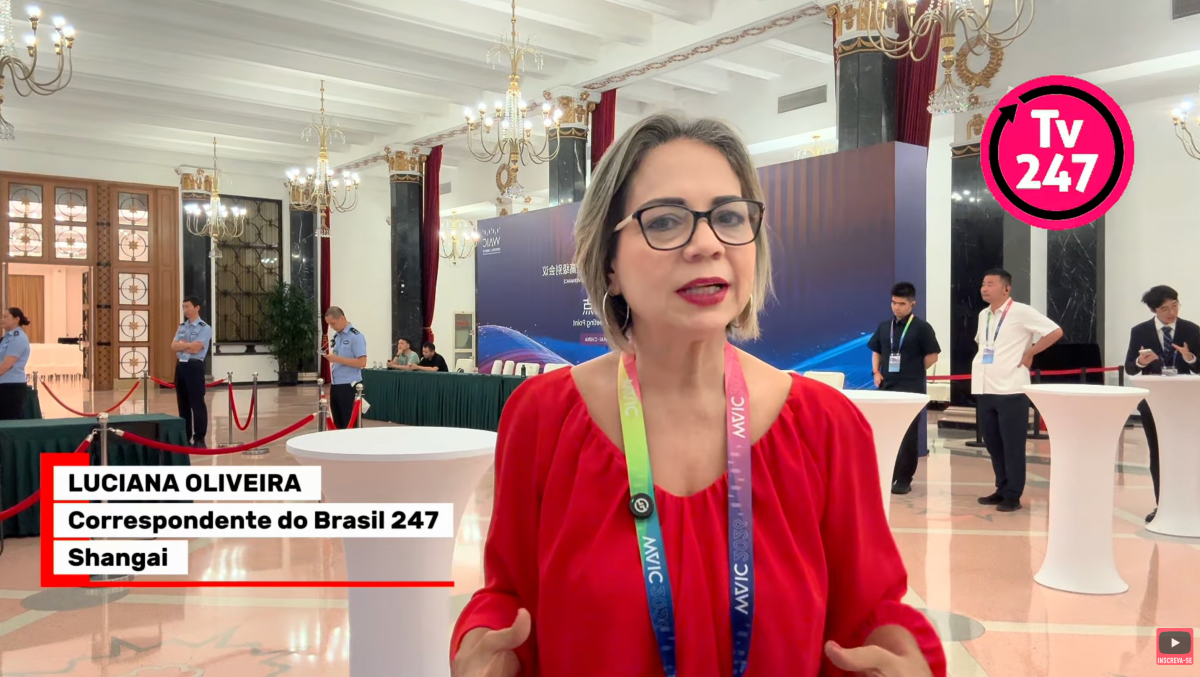
By Luciana Oliveira, Brazil 247 correspondent in China, from Shanghai – In yet another major strategic move to consolidate its leadership in international technology governance, China formalized this Thursday (16) an international cooperation agreement in Artificial Intelligence (AI) with foreign partners. The initiative aims to structure and reinforce multilateral collaboration mechanisms in research, development, security and, above all, the regulatory governance of AI.
The announcement of the treaty comes at a surgical moment: the eve of the opening of the World Artificial Intelligence Conference (WAIC), which takes place in Shanghai between the 17th and 20th of July. The event, consolidated as one of the largest and most influential stages for technological discussion on the planet, will serve as a great showcase for the guidelines that the second largest economy in the world intends to project for the rest of the globe.
Xi Jinping’s political weight and the Global South
Unlike strictly corporate fairs promoted by the Western technology ecosystem, the conference in Shanghai takes on a strong state summit character. The participation of Chinese President Xi Jinping is confirmed, who will make a speech focused on presenting Beijing’s perspective on global AI governance.
The president’s presence reinforces that, for the Chinese government, artificial intelligence has gone beyond the borders of the productive sector and has become one of the main tools of diplomacy and sovereignty in the 21st century.
The articulation of the new agreement with foreign partners signals Beijing’s effort to pave a third regulatory path, attracting developing nations — especially from the Global South — to a less exclusive technological governance model that preserves national sovereignty, opposing the regulatory monopoly that large corporations based in the United States try to establish.
Research, Development and Security on the agenda
The central axes of the international treaty established this week focus on the dynamic balance between rapid scientific advancement and the operational security of new platforms.
The agreement provides:
- Direct scientific exchange: Integrated networks of universities and public and private research centers to accelerate solutions in neural networks and supercomputing.
- Cybersecurity protocols: Development of common barriers against malicious use of AI, massive data leaks and algorithmic manipulation of information.
- Ethics in Governance: Creation of multilateral guidelines to ensure that technological advancement goes hand in hand with social development, avoiding the deepening of global inequalities.
Shanghai as epicenter of technological debate
The choice of Shanghai as the WAIC headquarters is no coincidence. The Chinese metropolis has consolidated itself as a global innovation hub, concentrating some of the brightest academic and corporate minds on the planet. Over the next four days, the event will bring together high-level government delegations, CEOs of the largest Asian and global big techs, rectors of top universities and representatives of UN multilateral agencies.
With the recently signed pact under its arm and the presence of Xi Jinping on the pulpit, China makes it clear to other global actors that the future of artificial intelligence will not be decided unilaterally in Silicon Valley, but rather on international cooperation platforms that respect multipolarity and collective security.
Source: www.bing.com
Source link