An alternative material to cement, developed by researchers at the University of Delaware (USA), withstood six months of exposure to the extreme conditions of space, after remaining installed outside the International Space Station (ISS).
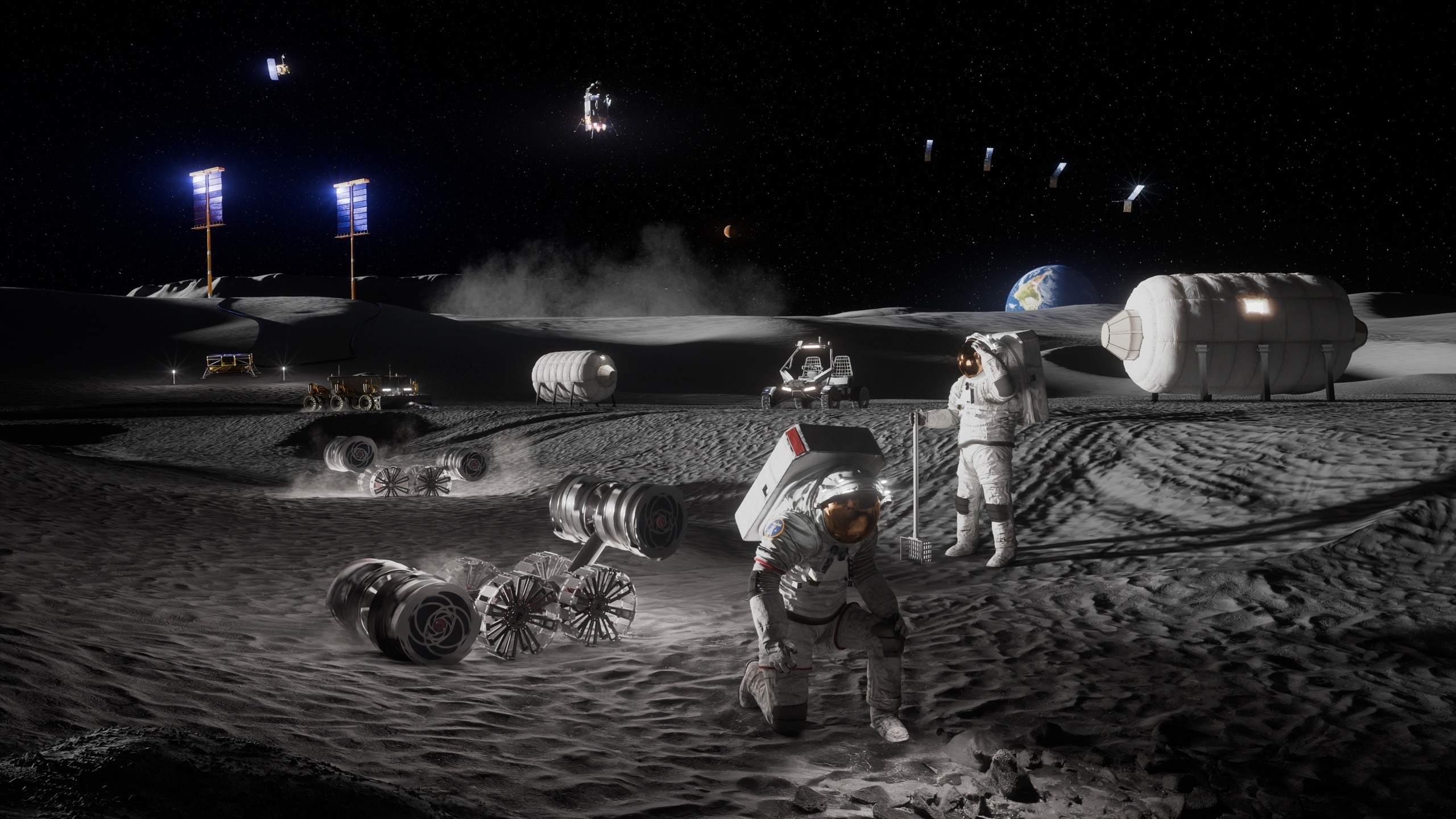
In some tests, the samples returned to Earth with greater mechanical resistance than identical samples that remained stored in Earth’s soil. The results reinforce the possibility of using this type of material in the construction of infrastructure on the Moon, where transporting cement from Earth would be economically unfeasible.
Lunar regolith could be the raw material
- According to researchers, one of the alternatives for building structures on the lunar surface is in the Moon’s soil itself;
- The material used is regolith, the layer of dust and rock fragments that covers the lunar surface;
- “Regolith is essentially a silicate material similar to clay,” explained Norman Wagner, holder of the Unidel Robert L. Pigford Chair in Chemical Engineering at the University of Delaware, to Phys.org;
- “It is one of the most abundant materials on both the Earth and the Moon, which makes it interesting for construction.”
Wagner’s laboratory develops geopolymers, an alternative to traditional cement that bonds clay materials through chemical reactions, eliminating the need for manufacturing processes at high temperatures.
The objective is to produce construction materials using regolith with as few additives as possible, reducing the need for energy-intensive industrial processes. According to the researchers, this technology can also contribute to making civil construction more sustainable on Earth.
Test took place outside the ISS
To evaluate how geopolymers behave in space conditions, the team sent thin plates made with commercial simulants of lunar and Martian regolith to NASA’s MISSE-20 mission.
For six months, the samples remained fixed to the outside of the ISS, being exposed to the hostile environment of low Earth orbit.
After returning to the planet, the researchers verified that the materials showed no signs of deterioration. In some cases, the samples demonstrated greater strength than equivalent materials held on Earth during the same period.
The study was published in the journal Advances in Space Research.
AI helps predict material strength
In addition to withstanding the conditions of space, future construction materials for the Moon will need to be reliably produced directly on the lunar surface.
To address this challenge, the team carried out a second study, published in the journal Acta Astronautica using artificial intelligence (AI).
Continues after advertising
The researchers developed a machine learning model capable of predicting the strength of geopolymers based on the characteristics of the regolith used and the way the material is processed.
According to scientists, this approach considers that different types of lunar clays may have different properties, requiring specific manufacturing methods.
Study identifies critical moment during hardening
Other work conducted by Wagner’s laboratory investigated how geopolymers behave during the mixing, pumping and molding stages, before hardening.
Researchers have identified a transition point known as gel critical pointat which point the material stops behaving like a moldable paste and begins to form a solid structure.
The experiments showed that mixing or shearing before this stage did not change either the hardening time or the final strength of the material.
Continues after advertising
According to the researchers, this indicates that future engineers may have greater flexibility to manipulate and process construction materials on the Moon without compromising their quality.
This study was published in a special edition of the journal Journal of Rheology dedicated to the behavior of materials in environments beyond Earth.
Source: www.olhardigital.com.br
Source link