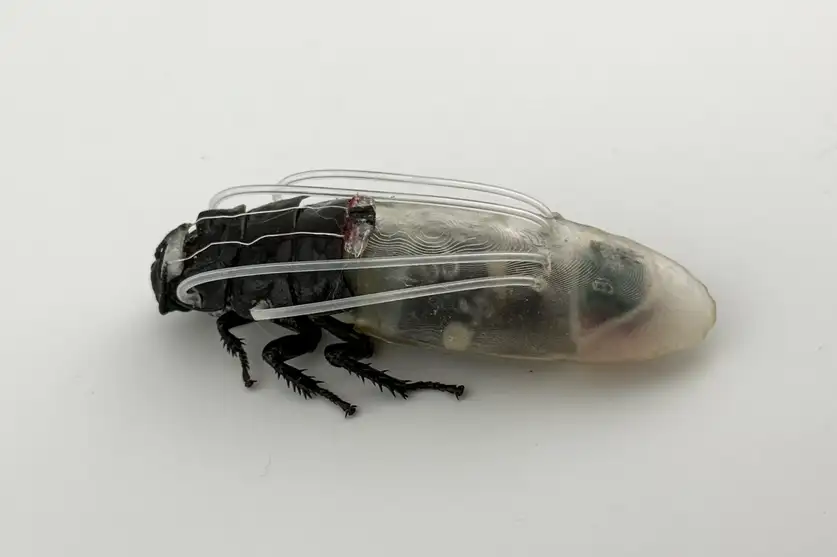
Cyborg cockroach with special costume. Reproduction/Nanyang Technological University
Researchers at Nanyang University of Technology in Singapore developed cyborg cockroaches capable of surviving for up to three hours in environments without oxygen.
The technology, which sounds like a science fiction scenario, was created to allow the use of these insects in rescue missions in areas hit by disasters and, in the future, in space exploration operations.
Cyborg cockroaches
Research conducted by Hirotaka Sato, professor coordinating the study, and his colleagues demonstrated, in 2021, that a species of cockroach originating from the island of Madagascar could be controlled remotely using electrodes inserted into its sensory organs.
Three years later, in 2024, the team was able to demonstrate that a group of these cyborg cockroaches could be coordinated jointly.
The proposal was for insects to be released on a large scale to help in the search for survivors of natural disasters.
The species already has efficient locomotion and reflexes capable of avoiding obstacles. But scientists wanted to go further and enable cockroaches to enter flooded search areas, common in these types of disasters.
From this, the group developed a “suit” that allows the insect to move underwater for up to three hoursat depths of up to 50 centimeterswithout side effects.
Scientists developed and 3D printed a resin suit that protects the cockroach’s respiratory cavities from water — the spiracles, located in the insect’s thorax.
To solve the issue of lack of oxygen, the researchers stored two chemical agents in the suit: hydrogen peroxide and manganese dioxidewhich, when reacting, produce oxygen capable of being absorbed by the insect.
Research impact
The idea of using small agents to help search for survivors and monitor inhospitable locations is nothing new.
In an interview with the magazine New ScientistAlan Winfield, a researcher at the University of the West of England, explained why cockroaches are used in this type of project.
“There have been attempts to develop very small robots, but the problem is the battery: it is not possible to obtain very long autonomy”, explained Winfield.
According to him, cockroaches are more efficient than robots because, in addition to operating for longer without needing to be recharged, they can find their own food in nature.
The idea now is not only to use this technology in search and rescue operations during natural disasters, but also to adapt it to expand its use in space missions.
To this end, the group intends to test the effects of different extreme conditions on the suit to analyze its resistance limits.
Sato states that his biggest goal is to take this technology to space.
“It’s, in a way, a step — a big step — toward spacesuits for cyborg insects. For exploring the surface of Mars, for example,” said the researcher in an interview with New Scientist.
*With information from New Scientist
**Under the supervision of Renan Dantas
Source: www.moneytimes.com.br