Integrated electronic valves
Radio, television, sound equipment, and even the first computers were born thanks to electronic valves. All those pioneering electronic circuits were based on thermionic valves, components—or a series of components together—sealed in a vacuum inside a glass casing.
But they required high voltages and heated up as much as incandescent light bulbs, in addition to being difficult to miniaturize, which ultimately led to their replacement by silicon solid-state transistors.
More recently, however, vacuum planar electronic valves , manufactured with modern microelectronics technology , have been experiencing a resurgence of that technology as a potential successor to solid-state transistors because electrons in a vacuum can travel at speeds close to that of light, which is 1,000 times faster than in silicon – even NASA is testing these new vacuum transistors.
However, these developments encountered a stumbling block: When the vacuum transistor gate attempts to control the current, the electrons end up hitting the gate itself instead of the anode, generating a leakage that makes the integration of these valves for the construction of functional circuits unfeasible.
Now, Wenjing Ying and colleagues from Shanghai Jiao Tong and Shaoxin universities in China have overcome this challenge by developing a fundamentally new principle for the operation of the new miniaturized electronic valves.
[Image: Wenjing Ying et al. – 10.1038/s41378-026-01234-z]
Modernized electronic valve
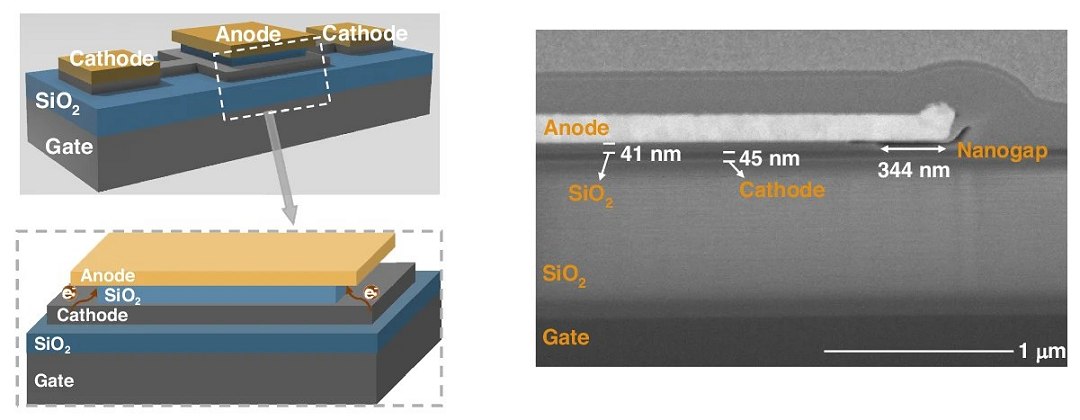
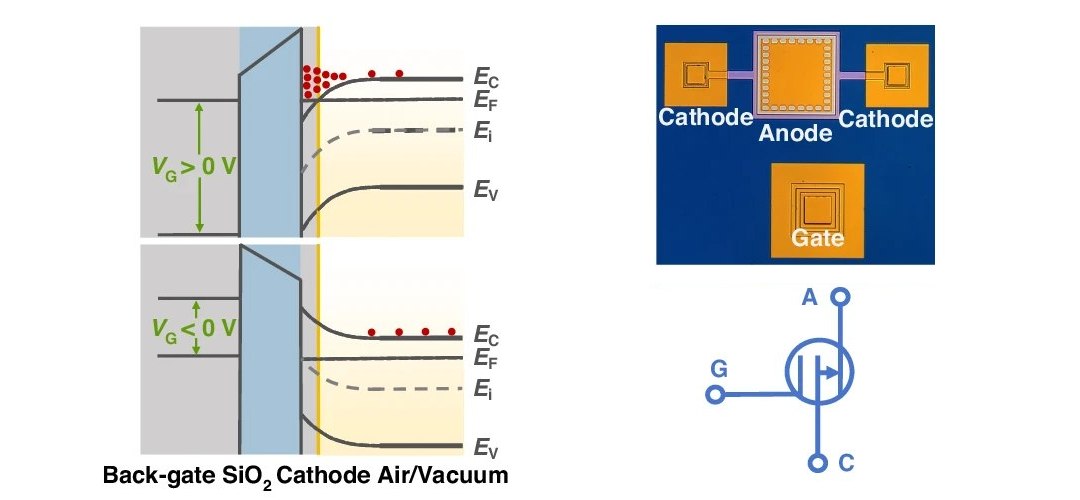
The new component consists of a cathode-modulated vacuum/air channel electronic valve that solves the current leakage problem through a clever inversion of functions: Instead of using the gate to block or divert electrons on their way to the anode, the gate modulates the electron concentration within the cathode itself. Meanwhile, a back gate, separated by an oxide layer, bends the energy band of the ultrathin silicon cathode (only 45 nm thick).
A positive voltage at the gate attracts electrons to the cathode surface, increasing the field emission current; a negative voltage repels electrons, reducing emission. As each electron leaving the cathode reaches the anode, the gate current is suppressed to values below 10⁻¹¹ A , several orders of magnitude smaller than any new-generation vacuum tube built to date.
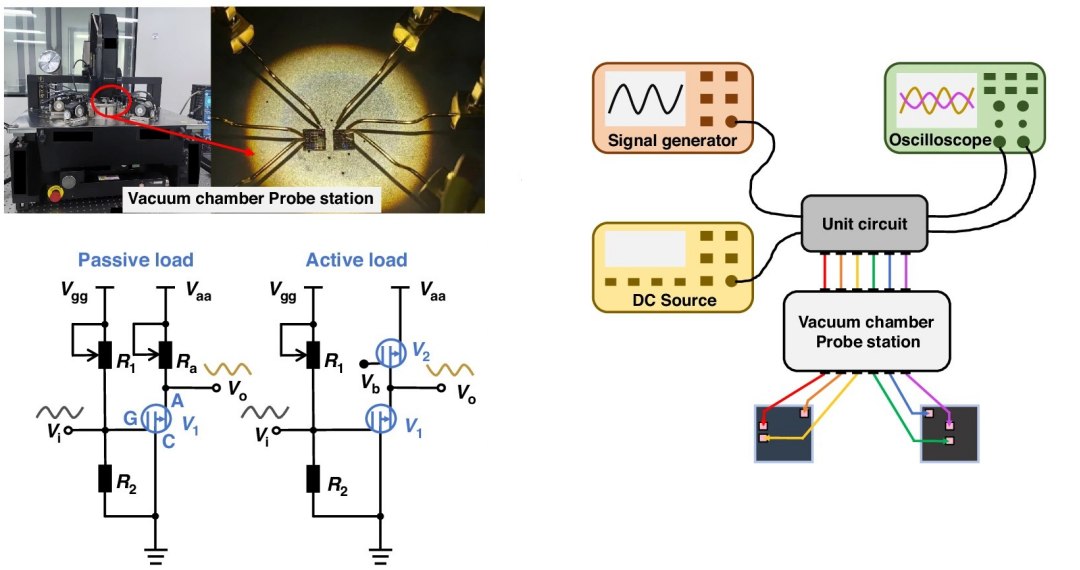
The component was manufactured using standard processes compatible with integrated circuits on silicon wafers on insulators. Prototypes were tested in source amplifiers, differential amplifiers, cascaded amplifiers, and even in NAND and NOR gates, marking the first time a vacuum/air channel electron tube has been successfully implemented in functional integrated circuit blocks – yes, these are electronic valves inside chips.
“We’ve been working on this problem for years because everyone knows that if we can get vacuum tubes working again on a chip scale, the speed advantage will be enormous,” the researchers wrote. “The reason previous attempts failed was always the same: current leakage at the gate. By controlling the supply of electrons at the cathode, instead of trying to capture electrons in the air, we finally eliminated this leakage. Seeing the same device working as an amplifier, a differential pair, and even a NAND gate on the test bench was the moment we realized this approach really has a future.”
[Image: Wenjing Ying et al. – 10.1038/s41378-026-01234-z]
Overcoming transistors
The immediate implication is that this technology opens a practical path for the fabrication of monolithic integrated circuits (chips) using vacuum tubes instead of silicon transistors, which will be able to operate at much higher speeds than current transistors, particularly in high-frequency applications and harsh environments where solid-state devices present problems.
Since vacuum channels are immune to radiation and operate over wide temperature ranges, circuits based on these state-of-the-art microvalves could be used in aerospace, defense, and satellite electronics – the manufacturing process is already compatible with industry-standard integrated circuits.
Although the demonstration device is not yet saturating, a deficiency that limits gains in some configurations, the team states that reducing this effect is plausible and is the next research goal. What is cause for celebration, they emphasize, is that a decades-long obstacle to the use of faster technology has finally been removed.
Source: www.inovacaotecnologica.com.br
Source link