
Earth’s atmosphere is essential for life, but it represents a major obstacle to astronomy. Even on seemingly calm nights, air turbulence distorts starlight, causing the well-known twinkling effect. To overcome this problem, scientists have developed an ingenious solution: creating artificial stars with lasers, according to information from the portal IFLScience.
This technique is part of so-called adaptive optics, a system that uses deformable mirrors and computers to correct, in real time, distortions caused by the atmosphere. To work, the system needs a reference star close to the observed object.
For those in a hurry:
- Uses lasers to create artificial stars in the atmosphere;
- Corrects distortions caused by air turbulence;
- Allows clearer observations from Earth;
- Integrates multiple telescopes into a virtual system;
- Achieves resolution comparable to that of space telescopes;
- It has already revealed unprecedented details of distant stellar regions.
When there is no suitable star, telescopes create one. Observatories such as the European Southern Observatory use lasers that excite sodium atoms at an altitude of around 90 kilometers. This process generates a bright point in the sky, functioning as a perfectly known artificial star, which serves as the basis for optical adjustments.
Combined telescopes increase precision
One of the most advanced systems using this technology is the Very Large Telescope Interferometer. It combines four 8-meter diameter telescopes to form a single “virtual telescope”, with resolution equivalent to the distance between them.
This type of interferometry requires extreme precision, which makes atmospheric correction essential. Recently, the system was improved in the GRAVITY+ program, which introduced new lasers and improvements in observation capabilities.
Detailed images of distant regions
One of the most impressive results of these improvements was the observation of the Tarantula Nebula, a star-forming region located in the Large Magellanic Cloud, approximately 160,000 light-years from Earth.
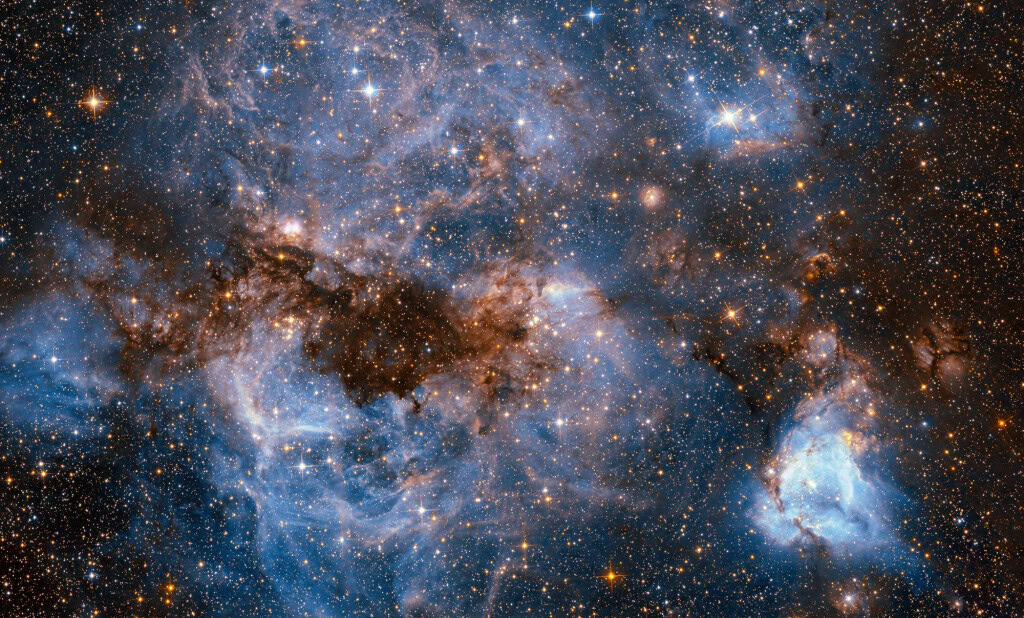 Systems like the Very Large Telescope Interferometer combine multiple telescopes to achieve resolution comparable to that of space instruments. (Image: SRStudio / Shutterstock.com)
With the new technology, astronomers were able to distinguish two separate binary stars within an extremely dense cluster, something that requires resolution comparable to that of space telescopes.
Technology brings terrestrial observatories closer to space
In addition to improving image quality, adaptive optics allows telescopes on the ground to achieve levels of precision previously exclusive to instruments in orbit. This significantly expands the observation potential without the need to launch new telescopes into space.
The combination of lasers, sensors and advanced computing shows how engineering can overcome natural limitations, opening new windows for exploring the Universe.
Source: www.olhardigital.com.br
Source link