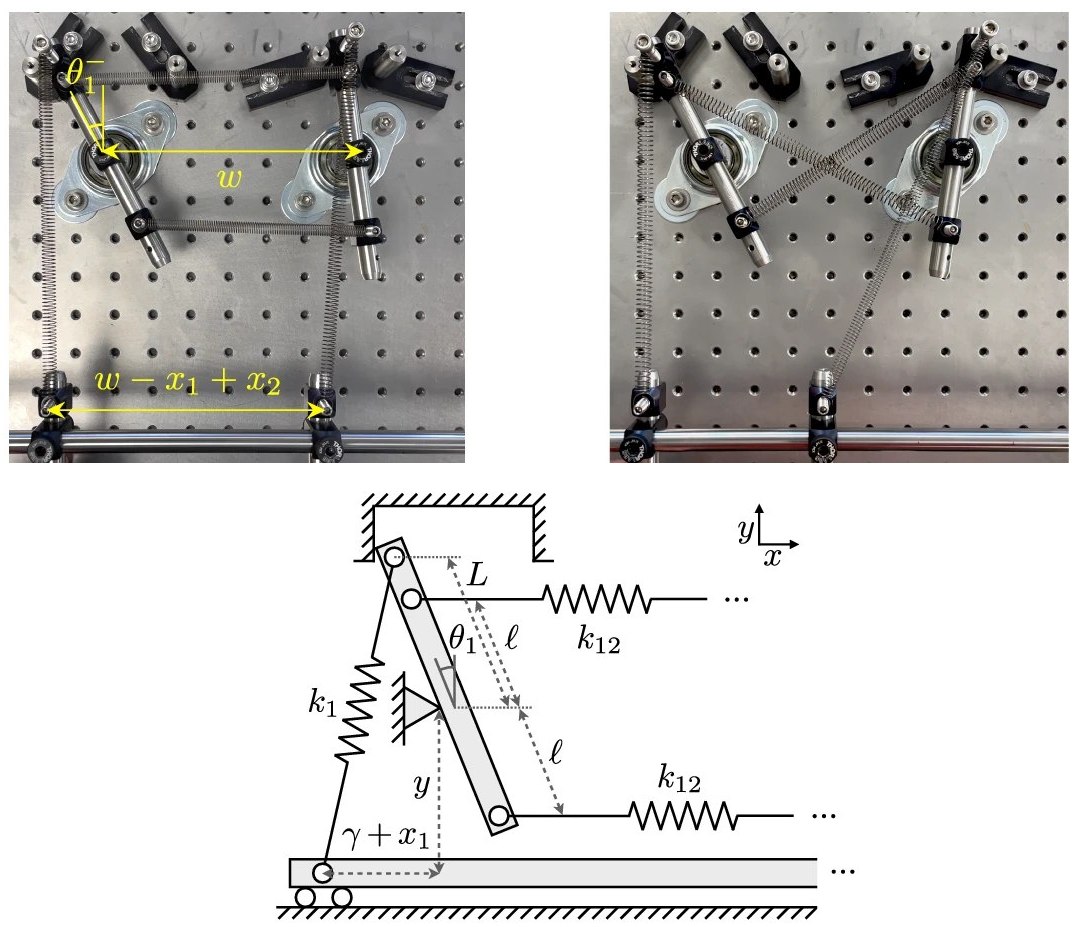
Now, Faten Ardat and a group of students from Syracuse University and St. Olaf College in the USA have built a computer using only mechanical components that performs simple calculations without relying on electricity or batteries – everything is done manually, “by hand,” so to speak.
In fact, the team used common materials, such as springs and steel bars, to create three mechanical computational machines capable of performing simple logical operations. The first counts how many times it is pulled forward and backward; the second reports whether the number of times it was activated is even or odd; and the third can memorize whether it received a medium or strong force when activated.
The idea is to demonstrate that mechanical computers can be a viable alternative to conventional computers in harsh environments, such as extreme temperatures or exposure to corrosive chemicals or radiation – at least in situations where simple calculations are sufficient to perform the work.

Hysteron
Instead of transistors, the fundamental building blocks of mechanical computers are called hysterons, a term derived from the concept of hysteresis , a property in which the system’s response depends not only on its current input or external conditions, but also on its history or past states, a kind of memory.
In practice, there is a delay in response to a stimulus, and hysterons are the individual components that explain this “delay” in reacting to changes in their environment.
Just as non-living materials have memory, learn, and react to their environment , it is possible to use these elementary units to respond to mechanical stimuli in precise and targeted ways. In the three cases demonstrated here, the mechanical stimulus is simply the manual activation of a mechanical bar.
“Our results represent an important step toward the development of materials capable of perceiving their environment, making decisions, and reacting,” said Professor Joey Paulsen. “Often called smart materials, what we’ve learned could help improve people’s lives by enabling more responsive prosthetics or tactile environments.”
The idea now is to focus on the scalability possibilities of the technology and to verify its limitations. In terms of functionality, the team intends to study how the state of one rotor affects its interaction with a second rotor and, potentially, with a third, in order to create more complex computations.
Source: www.inovacaotecnologica.com.br
Source link