Sunflower seed battery
Sodium-ion batteries seem to be all the rage in the current wave of electrification: In addition to storing twice as much energy and desalinating seawater , sodium is abundant and widely accessible, unlike lithium.
But everything that is good can be improved, as Nekane Nieto and colleagues from the University of the Basque Country in Spain have just demonstrated.
Batteries consist of a positive terminal (cathode), a negative terminal (anode), and an electrolyte, which allows the movement of ions from one terminal to the other, thus generating an electric current.
Nieto then decided to develop anodes based on carbon obtained from biomass, testing various possibilities such as coffee grounds, plant stems, invasive shrub species, grape seeds and skins, corn cobs, and even a compound made from organic waste.
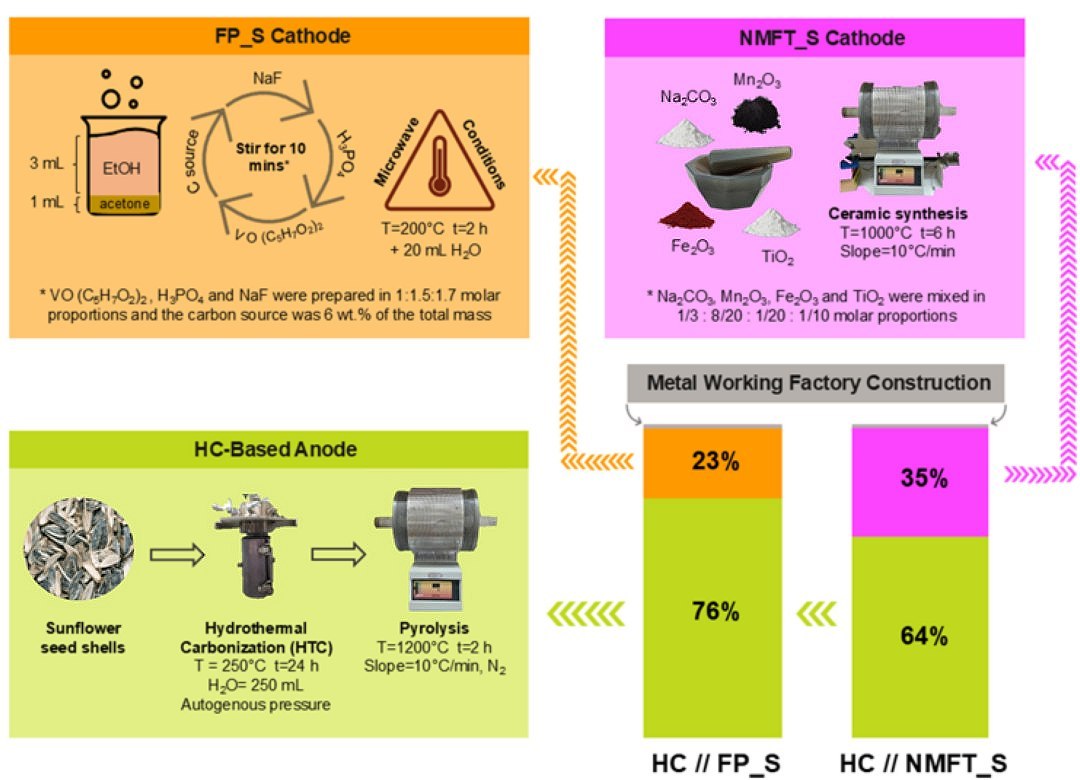
“But, of all of them, it was the carbon produced from sunflower seed husks that showed the best results,” the researcher said. “After optimizing this anode made from sunflower seed husks, we combined it with several different cathodes in rechargeable button batteries, which contain vanadium, iron and/or titanium in their composition, elements that are not as critical and are used in smaller quantities in these materials.”

[Image: Nekane Nieto a et al. – 10.1016/j.jpowsour.2025.239089]
Batteries of the future
Biomass-derived batteries exhibited excellent long-term cycling stability, retaining 91% of their initial capacity with a discharge capacity of 105 mAh/g after 200 cycles at 130 mA/g.
To take the laboratory experiments a step further, the team conducted a life cycle analysis to determine which anode/cathode combination offers the best battery performance and the lowest environmental impact. Sunflower seed batteries won again.
“We achieved very competitive results compared to those described so far. These are rechargeable batteries made from sunflower seed shells, capable of storing a sufficient amount of energy and supporting up to 1,000 charge and discharge cycles, with the most environmentally friendly cathode chemistry selected for each application,” said the researcher.
However, there is still work to be done before sunflower seed batteries reach the market. They are still more expensive, and researchers have only built small prototypes, the size of button cell batteries. But the team is already working on developing larger batteries.
“We shouldn’t just focus on the batteries that are already on the market. It’s always possible to explore a range of approaches and improve sustainability by using waste that currently has no use. It’s important to keep in mind that we need to look for alternatives to lithium-ion batteries and that, in the future, the industry may use different types of waste to manufacture batteries, depending on their intended application,” Nieto concluded.
Source: www.inovacaotecnologica.com.br
Source link