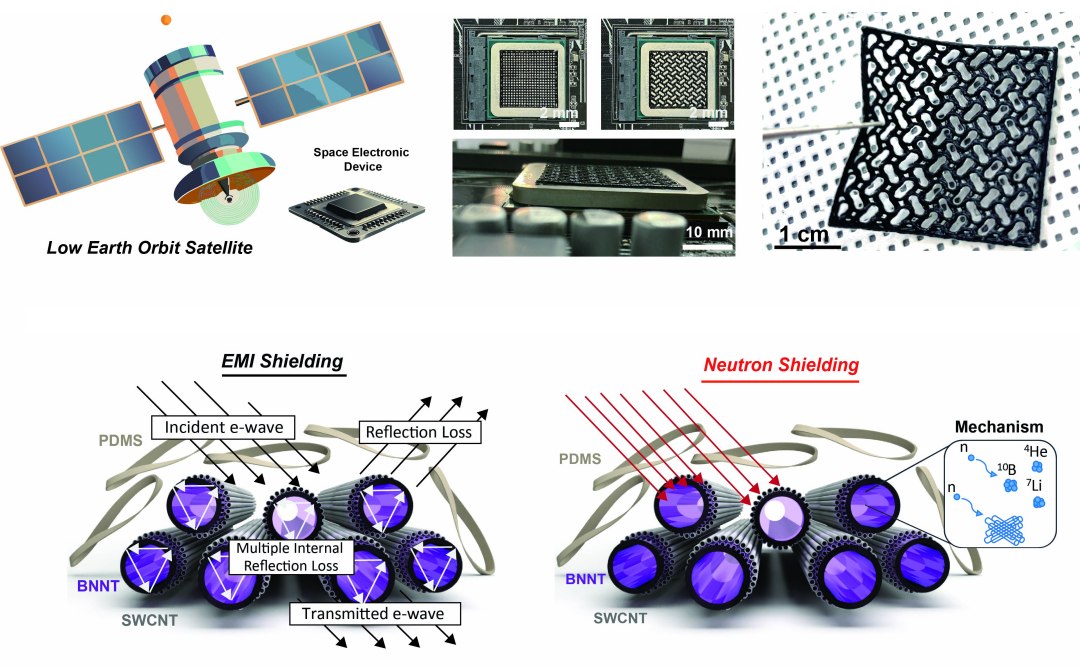
Thin and flexible shieldingThe renewed interest in space exploration has drawn attention to the need for a new generation of shielding materials capable of withstanding extreme environments, especially when spacecraft leave the protective bubble of Earth’s magnetosphere.
In space, electromagnetic waves and neutron radiation can cause malfunctions in critical components, such as computers, and health problems for astronauts. The problem is that these two types of radiation have different characteristics, and today they are blocked with different materials, increasing the weight and structural complexity of spacecraft.
This difficulty has just been overcome by a team from the Korean Institute of Science and Technology (KIST), which has created the first shielding material capable of simultaneously blocking electromagnetic waves and neutrons.
The key to this long-awaited innovation lies in the combination of two types of nanotubes : highly conductive carbon nanotubes absorb and reflect electromagnetic waves, while boron nitride nanotubes (BNNTs) capture neutrons with high efficiency.
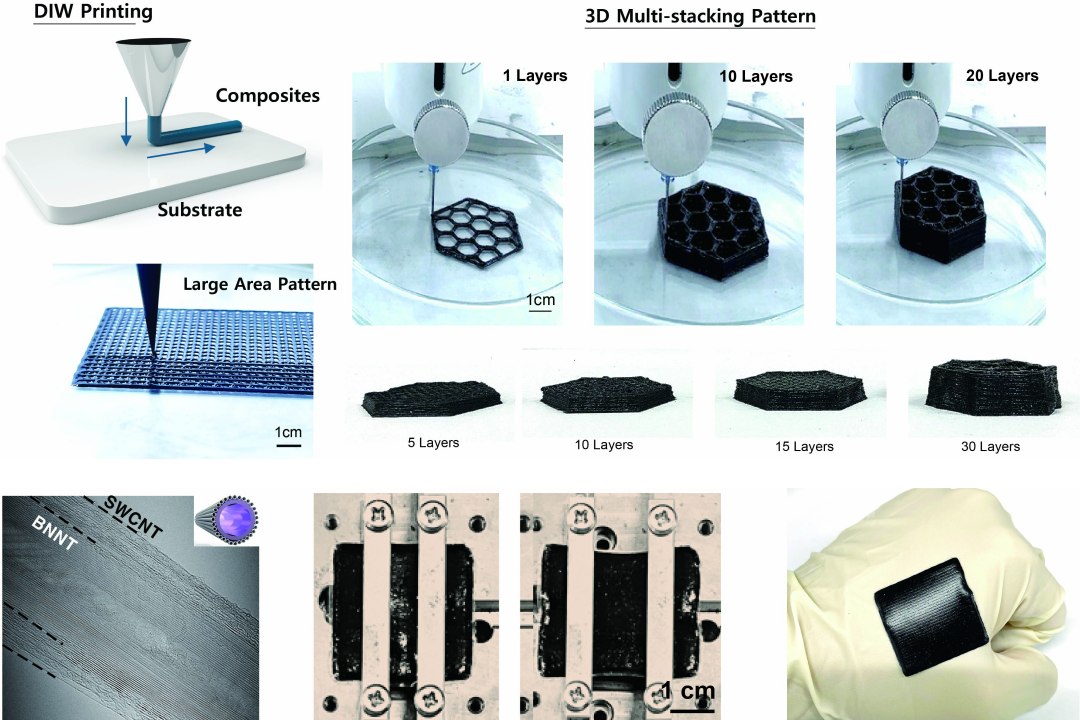
Because the two materials naturally form an intertwined structure, in which the two types of nanotubes mutually envelop each other, the result is a unique and cohesive coating, a film thinner than a human hair, as elastic as rubber, and suitable for 3D printing.
A single layer of the coating achieved a performance that blocks 99.999% of electromagnetic waves and reduces neutrons by approximately 72%. But, because it is very thin, the film can be layered, and it can also cover free-form shapes with even greater gains. The team tested honeycomb-shaped structures and found that the shielding effect increases by 15% compared to the flat material.
[Image: Flandy et al. – 10.1002/adma.202513805]
Radiation shield for multiple uses.
Blocking both types of radiation using a single, thin material opens up new possibilities across industry, simplifying design and reducing weight in a variety of areas, including satellites, space stations, nuclear facilities, cancer treatment equipment, and personal protective equipment.
“This material represents a completely new concept in shielding technology: It is as thin as adhesive tape and as flexible as rubber, simultaneously blocking electromagnetic waves and radiation. We plan to further enhance its performance through optimization of the structural design and actively pursue its application in real industrial environments,” said Professor Joo Yong-ho.
Source: www.inovacaotecnologica.com.br
Source link