Scientists have created a very thin plastic film that is capable of physically destroying viruses the instant these pathogens come into contact with its surface.
The expectation is that this innovation will enable the manufacture of coatings and utensils that help reduce the spread of diseases through frequently touched objects and surfaces, from cell phones and keyboards to handrails and hospital equipment.
And, in addition to its impressive effectiveness, the virucidal plastic film was also designed to be practical in the real world: Unlike previous antiviral surfaces made of metals or silicon, this new flexible plastic can be produced on an industrial scale.
“As nanofabrication tools improve, our results provide a clearer guide to which nanopatterns work best for killing viruses,” explained Samson Mah of RMIT University in Australia.
“Our mold can be adapted for roll-to-roll manufacturing, which means that antiviral plastic films can be produced on a large scale with existing factory equipment. We may one day have surfaces such as cell phone screens, keyboards, and hospital tables coated with this film, killing viruses on contact without the use of harsh chemicals,” added the researcher.
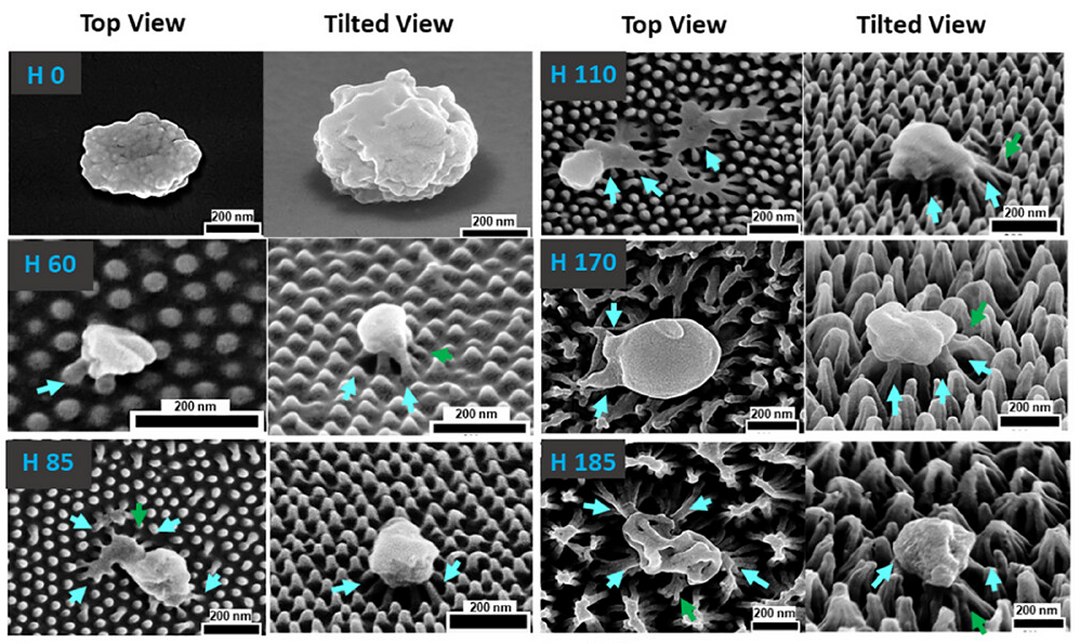
[Image: Samson WL Mah et al. – 10.1002/advs.202521667]
Soft nanotechnology
The antiviral film is made of acrylic and coated with extremely small structures, known as nanopillars or nanospikes. These tiny structures grab the virus and stretch its outer layer until it breaks. In other words, instead of relying on chemical disinfectants, the surface uses mechanical force to deactivate the virus.
In experiments using human parainfluenza virus 3 (hPIV-3) – which causes bronchiolitis and pneumonia – the results were impressive: Within one hour of contact, approximately 94% of the viral particles were fragmented or damaged to such an extent that they could no longer reproduce and cause infection.
Previous studies with rigid materials, such as silicon with nanospikes, have shown that viruses can be physically destroyed. This experiment expands on that idea, demonstrating that both pointed and rounded nanometric structures can be effective when arranged correctly. Furthermore, the team discovered that the proximity between the nanopillars plays a much more important role than their height – the most efficient distance is 60 nanometers between the pillars.
The team now plans to test smaller, non-enveloped viruses to determine the scope of application of the technology. “We believe this texturing is a strong candidate for everyday use and we are ready to partner with companies to improve it for large-scale manufacturing,” said Professor Elena Ivanova.
Source: www.inovacaotecnologica.com.br
Source link