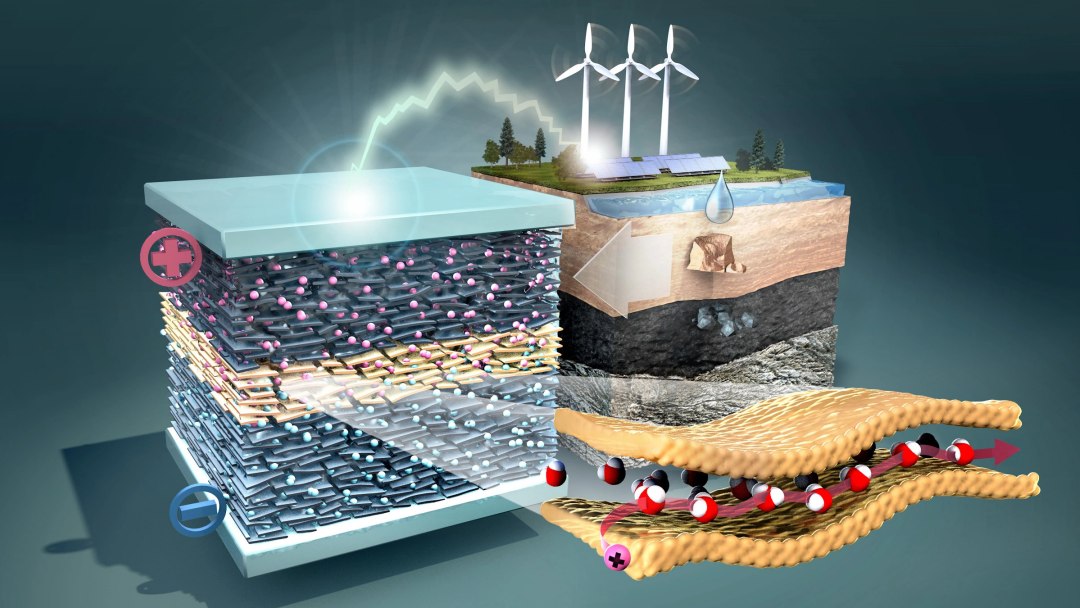
Is it possible to use pure water to store electrical energy?
Vasily Artemov and colleagues at the Hamburg University of Technology in Germany have just demonstrated that yes, it is possible – with a little help, of course.
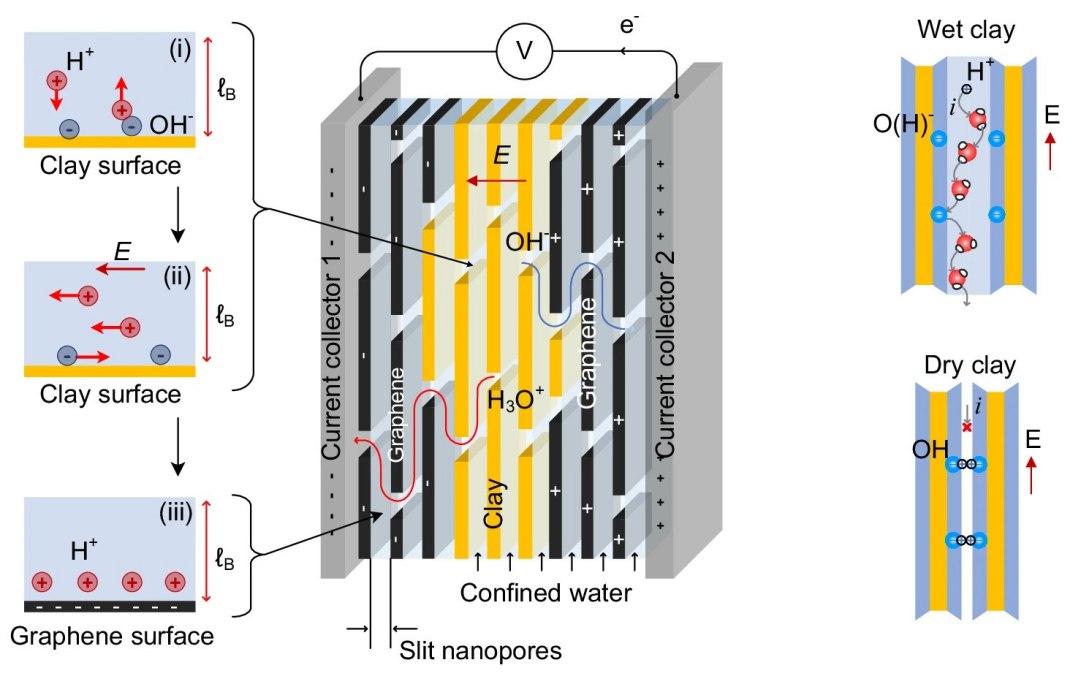
By confining water in nanometer-sized channels inside clay minerals, Artemov created a supercapacitor capable of efficiently storing and transporting electrical charges. Because of the use of water, the researchers call their device the “blue capacitor.”
While a battery stores energy through internal chemical reactions, a capacitor stores energy in a purely physical way, accumulating opposite charges on the surfaces of two conductive plates separated by an insulating plate. A supercapacitor is based on the same physical principles as a capacitor, but has a large surface area thanks to the use of porous materials, such as activated carbon.
The novelty here is the use of pure water as an electrolyte, the medium that carries the electrical charge, instead of metal plates. Batteries and supercapacitors typically rely on the addition of salts, acids, or other chemical electrolytes. This new supercapacitor works without these additives, using exclusively abundant and natural materials: water, clay, and carbon.
“Our goal is to develop safer and more sustainable energy storage technologies based on abundant materials, rather than complex chemical compounds,” said Artemov. “The device stores and releases energy efficiently, operates at a relatively high voltage for a water-based system, and remains stable over tens of thousands of charge cycles.”
[Image: Vasily Artemov et al. – 10.1038/s41467-026-73924-1]
Water capacitor
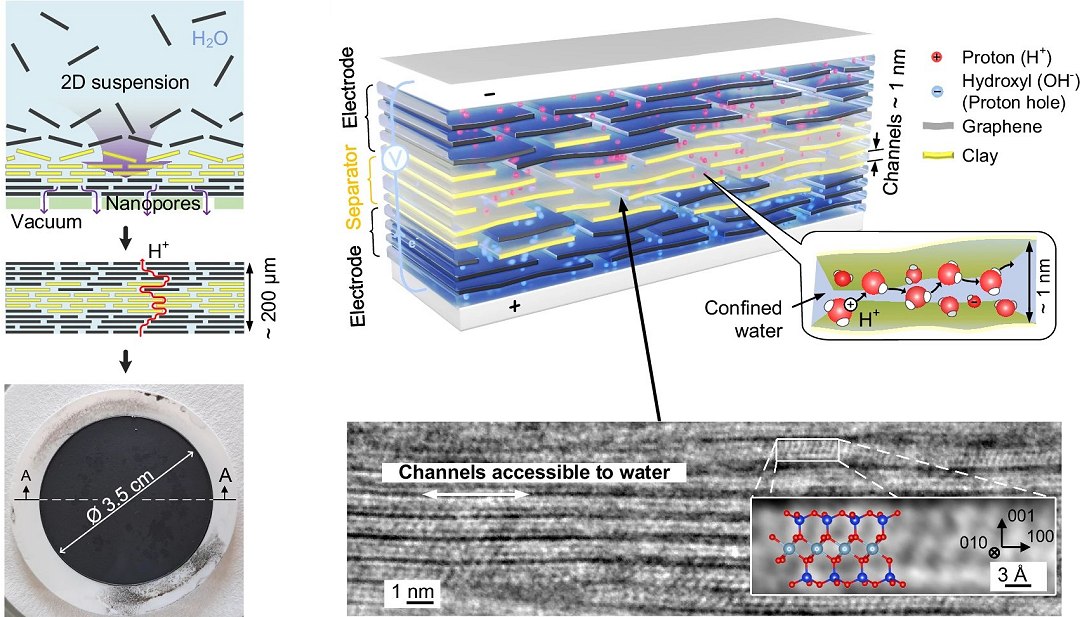
The key to the technology lies in channels about one nanometer wide, approximately 100,000 times thinner than a human hair. Trapped within such tiny spaces, the water exhibits properties not found in ordinary water in its free-flowing liquid form, allowing the charge to move efficiently.
To take advantage of this effect, the researchers combined clay minerals with sheets of graphene, which is a highly conductive form of carbon. Together, the layers form millions of tiny channels, which are then filled with water.
The blue capacitor maintained stable performance for over 60,000 charge and discharge cycles, operating at voltages up to 1.6 V, a high value for a water-based energy storage system and above the 1.5 V of a typical battery. Researchers consider this evidence that the unique properties of nanoconfined water can be leveraged for practical applications. “Our results show that nanoconfined water can serve as an active electrolyte in a practical energy storage device,” stated Artemov.
[Image: Vasily Artemov et al. – 10.1038/s41467-026-73924-1]
Future applications
This is just a first demonstration, but the team believes that, with the necessary developments, it is possible to envision future applications, such as the storage of renewable energy from solar and wind sources, support for electrical grids, and the supply of energy for devices that require frequent charging and discharging.
Furthermore, this practical demonstration could inspire new technologies that take advantage of the properties of water at the nanoscale, including sensors, bio-inspired systems, and even neuromorphic computing.
Source: www.inovacaotecnologica.com.br
Source link