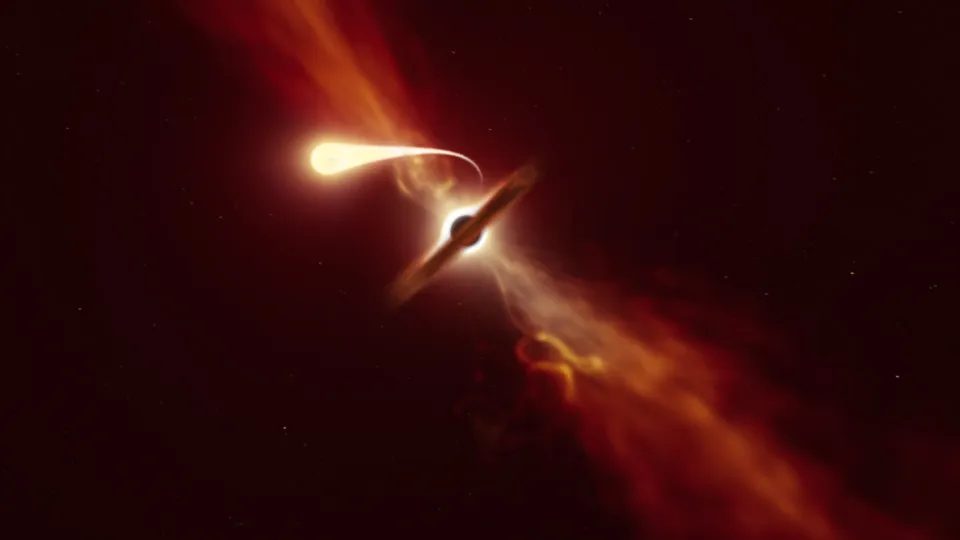
Although these types of supermassive “colossi” are normally studied because they devour matter and emit enormous amounts of energy, this case is different for researchers because the black hole is “asleep”, that is, it is not absorbing large amounts of matter, explained the University of Cantabria (UC), in Santander, Spain, in a statement.
Thanks to the capabilities of the James Webb Space Telescope, the research team, led by Andrew Newman, from the Carnegie Institution for Science, in the United States, was able to calculate the size of the object by observing the way it influences the stars orbiting around it.
The results were published in the journal Science, as reported on Friday by the Europa Press agency.
“Initially, the model was created to explain the Refsdal and Encore supernovae, but in the end, it helped us discover that there is a massive object at the center of the galaxy”, explained Spanish scientists José María Diego and Ana Acebrón, from the Observational Cosmology and Instrumentation Group at the Cantabrian Institute of Physics (IFCA, CSIC-UC).
For decades, astronomers have located giant black holes by observing extremely bright objects known as quasars. They function as true cosmic lighthouses powered by highly active black holes.
However, the object analyzed in this study belongs to a much more difficult to identify category: an extremely silent and inactive black hole.
Furthermore, researchers know that this gigantic black hole is located in a large galaxy called MRG-M0138, which formed most of its stars approximately 13 billion years ago.
Currently, this galaxy practically does not produce new stars, and its central black hole also remains inactive.
Until a few years ago, measuring the mass of black holes so far away was practically impossible.
In this new discovery, the team analyzed the collective motion of stars in the MRG-M0138 galaxy.
This kind of “stellar dance” made it possible to calculate the mass of the black hole using data from the James Webb Space Telescope and taking advantage of a natural phenomenon known as gravitational lensing, which magnifies the light from extremely distant objects and facilitates their observation.
“We can now detect this type of inactive black hole even when the Universe was just 10 billion years old,” explained Newman.
“The combination of the clarity provided by the James Webb telescope and the magnifying effect of gravitational lenses makes this possible,” he concluded.
Source: www.noticiasaominuto.com.br
Source link