We’ve spent the last decade treating the cloud as the ultimate destination for almost everything. We migrated our databases, our apps and our first‑generation AI models into distant data centers owned by public cloud providers — and for many workloads, that still makes sense. But as we shift from “AI as a chatbot” to “AI as the core of business operations,” the physics of a cloud‑only model are starting to let us down.
The reality is that for a factory floor, a surgical robot or an autonomous retail system, the cloud is just too far away to make the right decision at the right time.
If you’re a CTO or an infrastructure lead, you’re hearing the buzz about Edge AI and wondering if it’s just another layer of complexity. It’s tempting to dismiss it as “small cloud.” It isn’t. Edge AI is a fundamental shift in how we manage data. It’s the realisation that moving terabytes of raw data across a continent just to make a decision in a few milliseconds isn’t just costly, it’s a bottleneck that strangles innovation.
The physics of frustration
Think of it this way: when someone touches a hot stove, their hand doesn’t wait for a signal to travel to the brain, get processed and then return with a “move your hand” command.
If it did, they’d be in the ER. The human nervous system handles that reflex locally. That’s what Edge AI does for enterprise infrastructure.
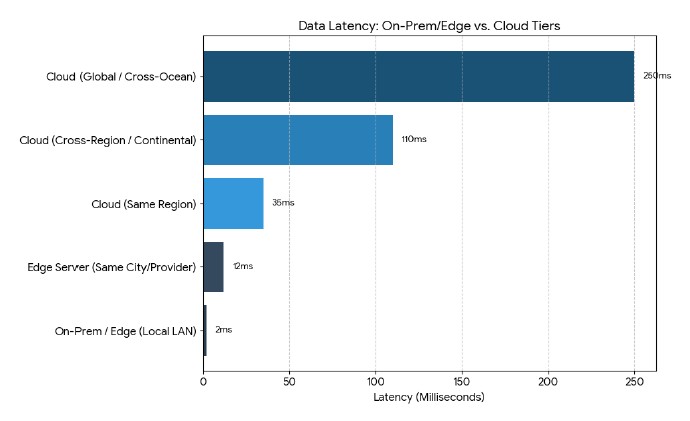
In the cloud‑centric model, we suffer from the “round trip.” Even with the fastest fiber, you’re contending with latency, jitter and the sheer gravity of data. When you’re running high‑fidelity computer vision to spot a hairline fracture in a turbine blade spinning at 3,000 RPM, a 100‑ or 200‑millisecond delay isn’t an inconvenience: it’s a failure.
The cloud remains the right place for training models, the heavy lifting that demands massive GPU clusters and weeks of “thinking.” But when it comes to inference, the moment the model actually makes a decision, that action needs to happen where the data is born, closer to the edge on hardware built for it.
Bringing the muscle to the mud
For years, “the edge” was a hostile environment for high‑performance computing. You couldn’t realistically put racks of delicate, power‑hungry servers in the back of a delivery van or on a humid, dust‑filled manufacturing floor.
That’s where the infrastructure conversation has shifted. We’ve moved past underpowered “gateway” devices that could forward data but not think about it. Today, we have localised compute that matches data centre-class performance and can withstand harsh, real-world conditions.
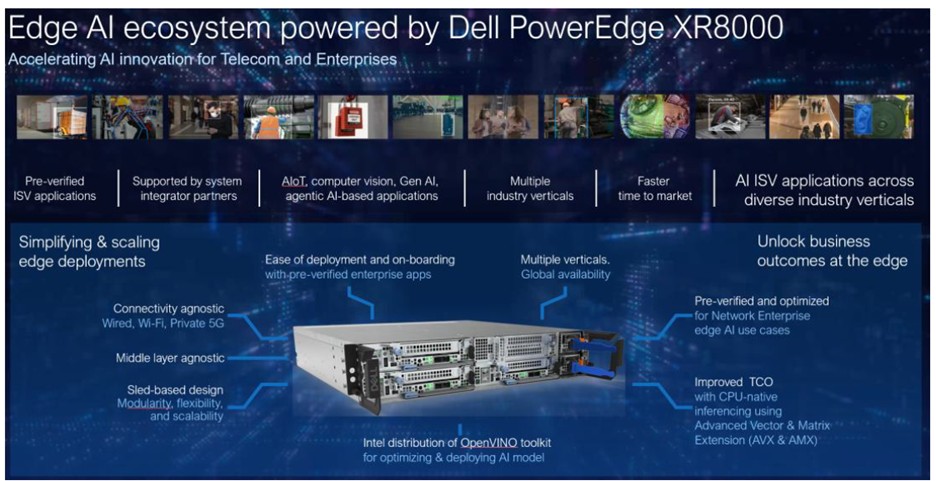
Systems like the Dell PowerEdge XR-Series have effectively rewritten the rules of where a “server” belongs. These aren’t just smaller boxes; they’re rugged, high‑density platforms engineered to withstand heat, vibration and dust while providing GPU acceleration to run complex neural networks in real time.
When we talk about the XR‑Series, we’re highlighting a strategic shift. It involves having enough “horsepower” at the edge to perform local analytics and accelerate inference without relying on a distant hub. For a CxO, this means resilience. If the WAN fails, the factory keeps operating because the “brain” is just ten meters from the assembly line, not two states away.
Where the rubber meets the silicon
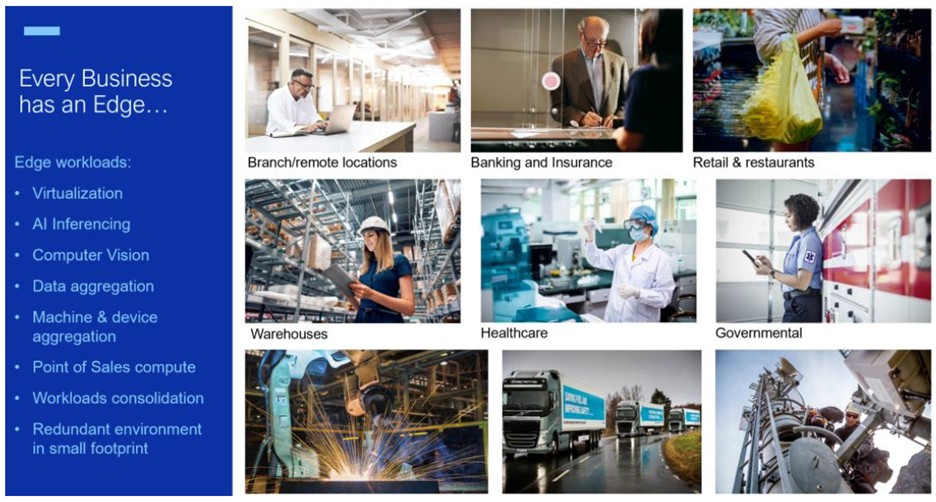
So, what does this look like in practice? It’s not just about faster spreadsheets. When it comes to smart manufacturing, for example, we’re seeing factories deploying hundreds of high‑resolution cameras to monitor every movement on the floor. If you tried to stream all that video to the cloud, your bandwidth bill would far exceed your payroll. With Edge AI on rugged PowerEdge XR servers, local infrastructure processes the footage, detects a safety hazard or fault and triggers an immediate stop. Only the summary of the event, not gigabytes of raw video, ever needs to reach the cloud.
In AR/VR, particularly in industrial digital twins, the stakes are even higher. For a technician wearing a headset to see real‑time overlays of engine schematics, latency has to be close to zero. Any lag between head movement and digital overlay creates the “barf factor,” the physical discomfort from sensory mismatch. Local compute removes that delay, turning wearables from gimmicks into useful tools.
Even in logistics, sensors are shifting from “reporting” to “understanding.” An autonomous forklift doesn’t just see an object; it uses local inference to distinguish a cardboard box from a person and decides within milliseconds whether to swerve or stop.
The strategic payoff: More than just speed
If you’re reviewing your 2026–2027 roadmap, Edge AI shouldn’t be a “maybe.”
It’s how you unlock the value of data you’re already generating, but quietly discarding, because it’s too heavy or too sensitive to ship to the cloud.
The concrete benefit of platforms like the PowerEdge XR‑Series isn’t just surviving in a dusty cupboard; it’s the depth of insight you gain. When you can run local analytics, you gain practical “data sovereignty”. You decide what leaves the site, when and in what form.
You shrink your attack surface by not constantly transmitting proprietary operational data beyond your network boundaries.
Just as importantly, you improve your agility. In a cloud‑only world, you’re a passenger on someone else’s network. At the edge, running on rugged XR servers, you control the reaction time.
We’re heading toward a world where the cloud is no longer the default, but the amplifier, training large models and handling the heaviest, most centralized jobs, while your local infrastructure runs day‑to‑day AI operations close to the action.
The future is hybrid and local enough
Rising “per‑token” costs and GPU pricing are making cloud‑heavy AI unsustainable for many products. Smart organisations are turning to smaller, quantised models, efficient, distilled AI designed to run on local hardware, from Neural Processing Units (NPUs) at the device level to PowerEdge XR servers at the edge.
You’re already seeing this in consumer life with features like Face ID and health tracking, where data is analysed in real time without an internet connection. In the business world, the same pattern means investing in NPUs and edge‑ready servers to handle the demanding tasks right where data is created.
By processing data at the source, you’re not just reducing latency for a better user experience. You’re also improving privacy and regulatory compliance in ways a cloud‑only approach can’t easily match.
The next phase of AI won’t revolve around ever‑larger models in distant data centres. Instead, it will be shaped by a hybrid model: the cloud for complex training, and rugged PowerEdge servers and local hardware for real‑time decisions where your business actually runs.
It’s time to stop treating the cloud as the centre of everything and start building your AI infrastructure where the action really happens.
The time for the round trip is over. The future is local.
Dell reported this
Source: www.dell.com
Source link